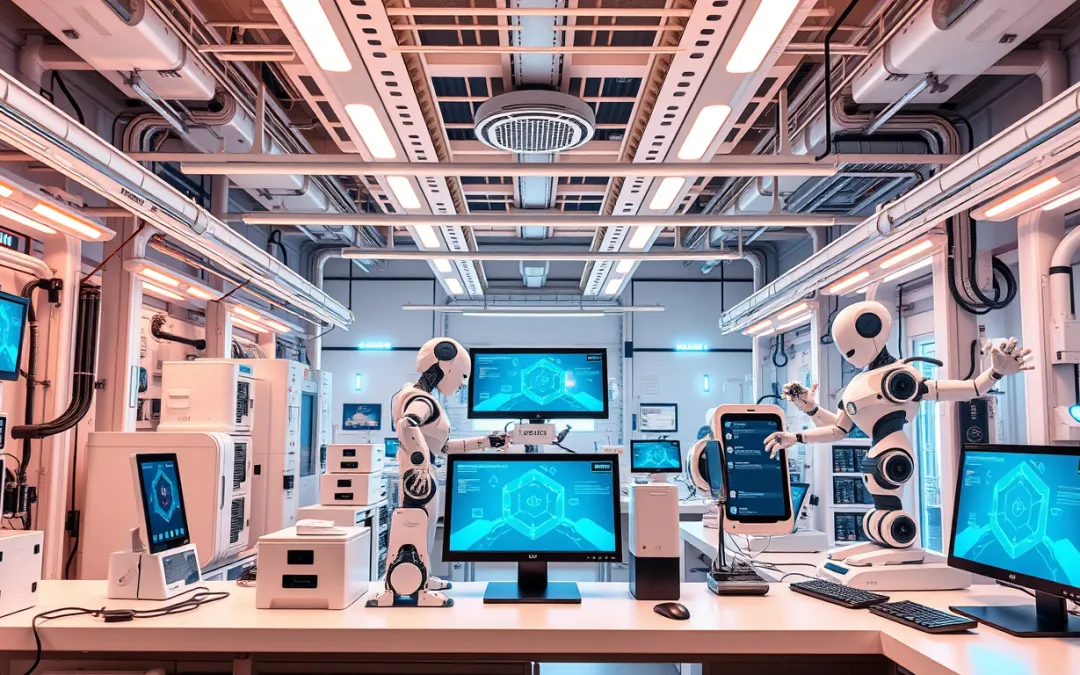
In today’s fast-paced business environment, the demand for higher efficiency and productivity is greater than ever.

Automation systems have emerged as a powerful solution to streamline operations, reduce costs, and enhance accuracy across various industries.

This comprehensive guide will delve into the essentials of automation systems, exploring their myriad benefits, different types available, key components that make them effective, the challenges businesses may face during adoption, and future trends that promise to shape the landscape of automation.

Whether you are a seasoned professional or a newcomer interested in implementing automation, this article will provide relevant insights to help you understand the transformative potential of automation systems.

Blind Solutions Consultancy Packages Available

Revolutionizing Efficiency: A Comprehensive Guide to <b>Automation Systems</b>‘ style=’display: block; margin: auto; max-width: 100%; height: auto;’></p><h2>Key Takeaways</h2><ul><li><b>Automation systems</b> significantly enhance operational efficiency and productivity.</li><li>Implementing <b>automation systems</b> can lead to substantial cost savings and reduced human error.</li><li>There are various types of <b>automation systems</b>, including fixed, programmable, and flexible systems.</li><li>Understanding the key components of <b>automation systems</b> is crucial for successful implementation.</li><li>Future trends indicate an increasing integration of AI and IoT in <b>automation systems</b> for improved performance.</li></ul><h3>Introduction to <b>Automation Systems</b></h3><p>In today’s fast-paced technological landscape, <b>automation systems</b> have emerged as pivotal components for businesses striving for efficiency and productivity.</p><p>These systems are designed to operate processes with minimal human intervention, streamlining operations and reducing the likelihood of errors.</p><p>From manufacturing to service industries, <b>automation systems</b> enhance functionality by integrating various technologies, such as robotics, artificial intelligence, and machine learning.</p><p>This revolution not only simplifies tasks but also significantly cuts operational costs, making them invaluable in an increasingly competitive market.</p><p>As organizations look to increase their agility and response times, understanding the various types and benefits of <b>automation systems</b> becomes essential for leveraging their full potential.</p><h3>Benefits of Implementing <b>Automation Systems</b></h3><p>In today’s fast-paced business environment, the implementation of <b>automation systems</b> has emerged as a crucial strategy for enhancing operational efficiency and productivity.</p><p>One of the most significant benefits of <b>automation systems</b> is their ability to streamline repetitive tasks, allowing employees to focus on more strategic initiatives that require human creativity and problem-solving skills.</p><p>This not only boosts workforce morale but also translates into improved overall performance.</p><p>Additionally, <b>automation systems</b> reduce human errors, ensuring higher accuracy in data handling and minimizing costly mistakes.</p><p>Moreover, companies can achieve significant cost savings by automating routine processes, leading to better resource allocation and increased profitability.</p><p>As businesses continue to adapt to digital transformation, the integration of <b>automation systems</b> is becoming essential for maintaining a competitive edge in the market.</p><blockquote><p>‘Automation is cost cutting by tightening the corners and not cutting them.’ – Mark W. Johnson</p></blockquote><p><a href=Blind Solutions Consultancy Packages Available

Types of <b>Automation Systems</b>‘ style=’display: block; margin: auto; max-width: 100%; height: auto;’></p><h3>Types of <b>Automation Systems</b></h3><p><b>Automation systems</b> are integral to modern industries, improving efficiency and productivity across various sectors.</p><p>There are several types of <b>automation systems</b>, each designed to meet specific operational needs.</p><p>Firstly, we have industrial <b>automation systems</b>, commonly used in manufacturing environments to control machinery, processes, and equipment through the use of control systems such as programmable logic controllers (PLCs) or discrete controllers.</p><p>Another type is office <b>automation systems</b>, which streamline business processes and improve workflow through software applications, such as document management and communication tools.</p><p>Additionally, we find home <b>automation systems</b>, allowing homeowners to manage lighting, heating, and security systems via smart technology.</p><p>Lastly, there are embedded <b>automation systems</b>, which are specialized setups designed to perform dedicated functions within larger mechanical or electrical systems.</p><p>Understanding these different types of <b>automation systems</b> can help organizations choose the right technology solutions to enhance their operations.</p><h3>Key Components of <b>Automation Systems</b></h3><p><b>Automation systems</b> have become a critical aspect of modern industry, providing numerous advantages such as increased efficiency, reduced labor costs, and enhanced precision.</p><p>To understand how <b>automation systems</b> can transform operations, it is essential to recognize their key components.</p><p>Firstly, sensors play a vital role, gathering real-time data that aids in monitoring and controlling processes effectively.</p><p>Secondly, controllers, typically programmable logic controllers (PLCs), are responsible for interpreting sensor data and executing operational commands.</p><p>Additionally, actuators are crucial as they implement the physical movements required to carry out tasks, from moving a robotic arm to adjusting a valve.</p><p>Moreover, communication networks facilitate seamless interaction between various system components, ensuring they work harmoniously.</p><p>Finally, the user interface, including software and dashboard displays, allows operators to interact with the <b>automation systems</b>, providing them with the necessary insights to make informed decisions.</p><p>By integrating these components, businesses can optimize their production processes and drive innovation in their operations.</p><p><img data-lazyloaded="1" src="data:image/gif;base64,R0lGODdhAQABAPAAAMPDwwAAACwAAAAAAQABAAACAkQBADs=" data-src=